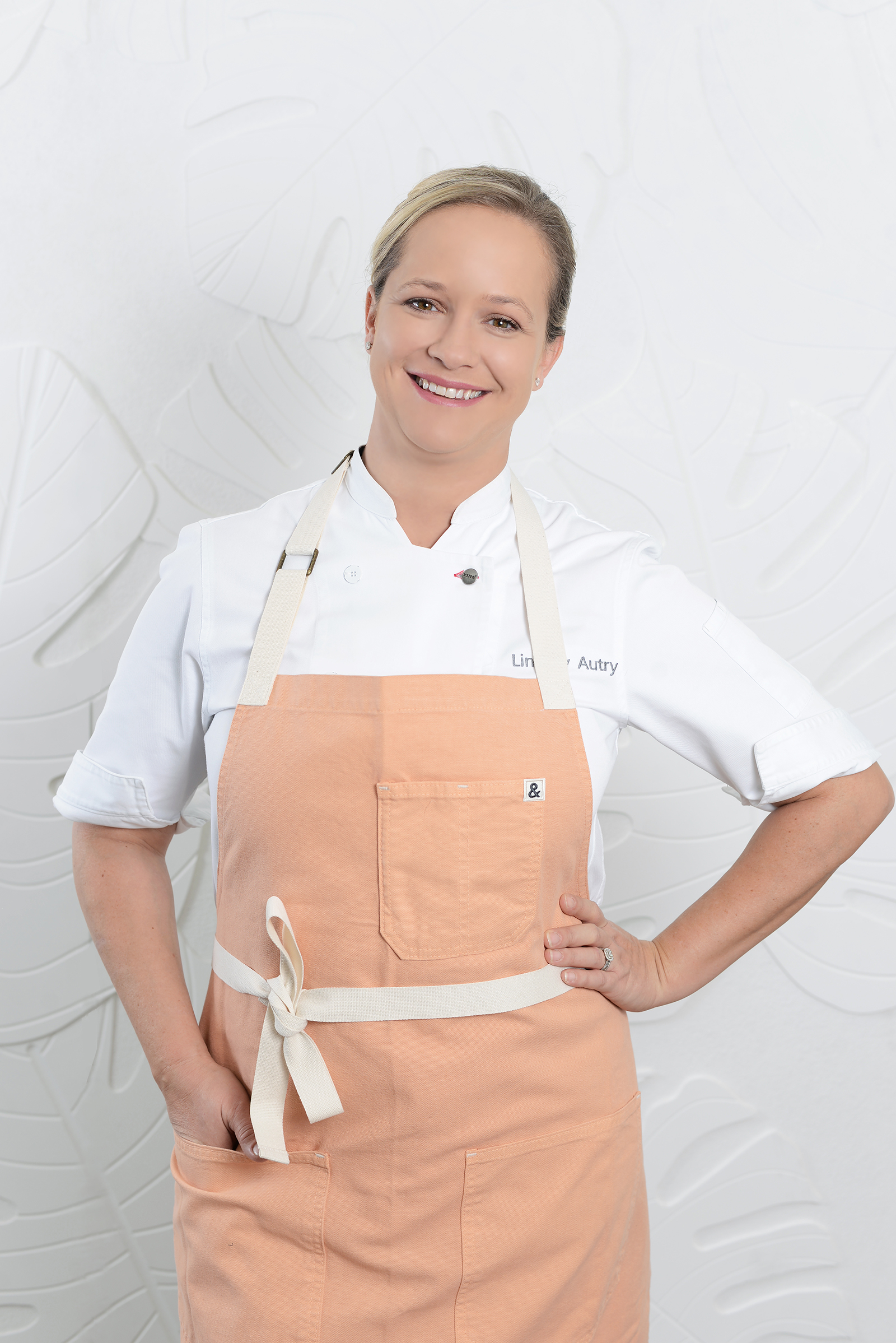
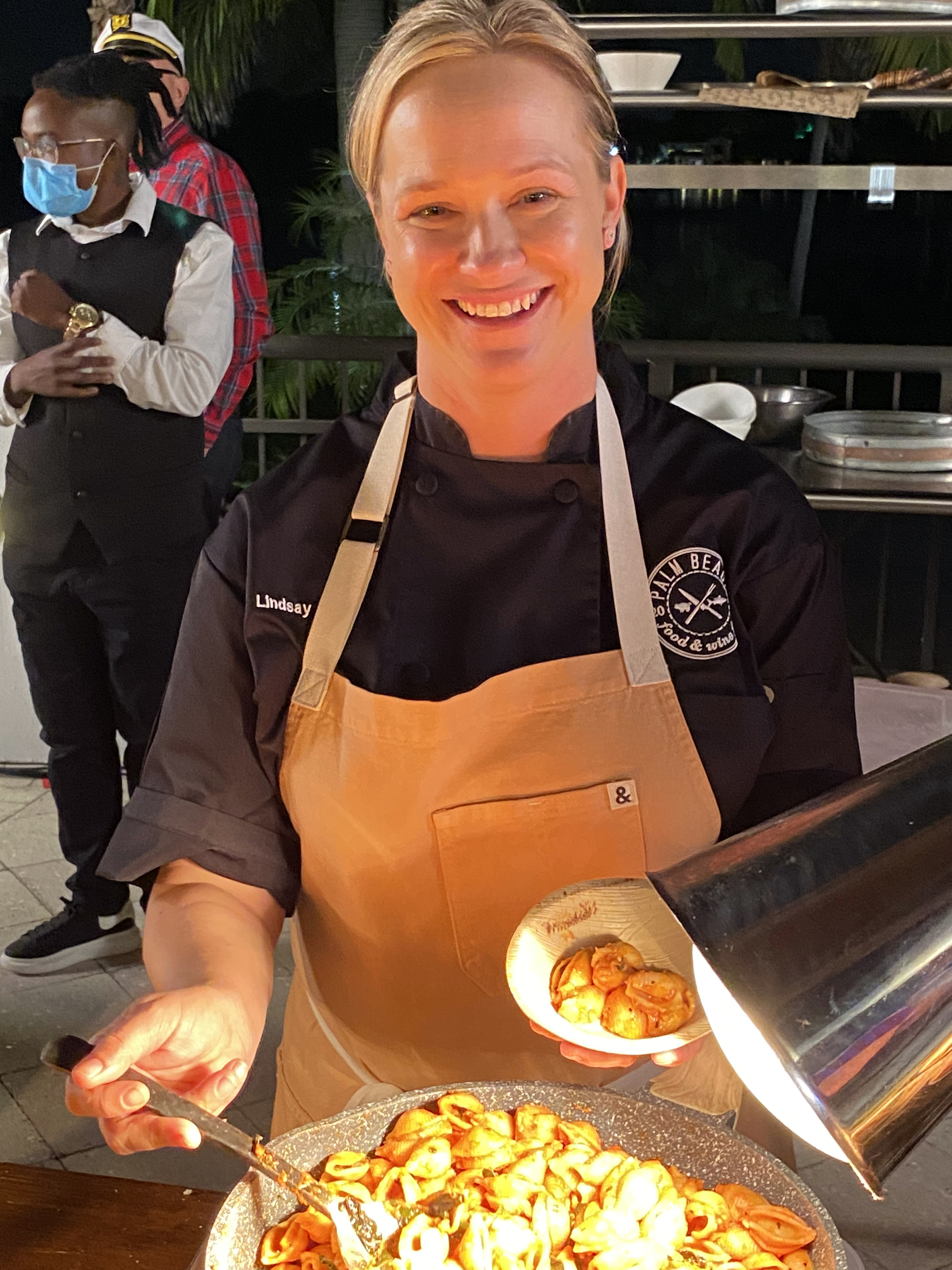
That’s Chef Lindsay Autry’s story.
The Chef, as her family likes to call her, grew up in her family’s peach orchard in rural Fayetteville, North Carolina. She learned how to preserve peaches and tomatoes and competed in cooking competitions.
A page straight from E.B. White’s Charlotte’s Web. It didn’t take long before Autry realized that cooking was not just a hobby but a career. “I was surrounded by food during my entire childhood,” says the Johnson & Wales University graduate who made headlines as a finalist on Bravo’s ninth season of “Top Chef.”
Her story has a happy ending. In the end, she finds her prince charming, David Sabin, Director of the Palm Beach Food & Wine Festival, and together they have an adorable two-year-old son named Jack.
From her traveling days, when she served as Chef de Cuisine of Las Brisas at Fairmont Mayakoba in Playa del Carmen in Mexico to her time in Miami where she first worked at Chef Michelle Bernstein Restaurant for over a decade, Autry admits she was fortunate enough to travel a significant amount in her career, cutting her teeth working with some incredible people like Chef Michelle Bernstein, who helped Autry find her niche by embracing French, Latin, and Mediterranean cuisines.
“Much of my inspiration comes from that nostalgia mixed with my professional training,” she says, as she recalls being in the kitchen on the farm back home. One of her grandmothers was Greek, and the other one was an amazing Southern cook. So she was fortunate enough to grow up with a lot of delicious, home-cooked meals.
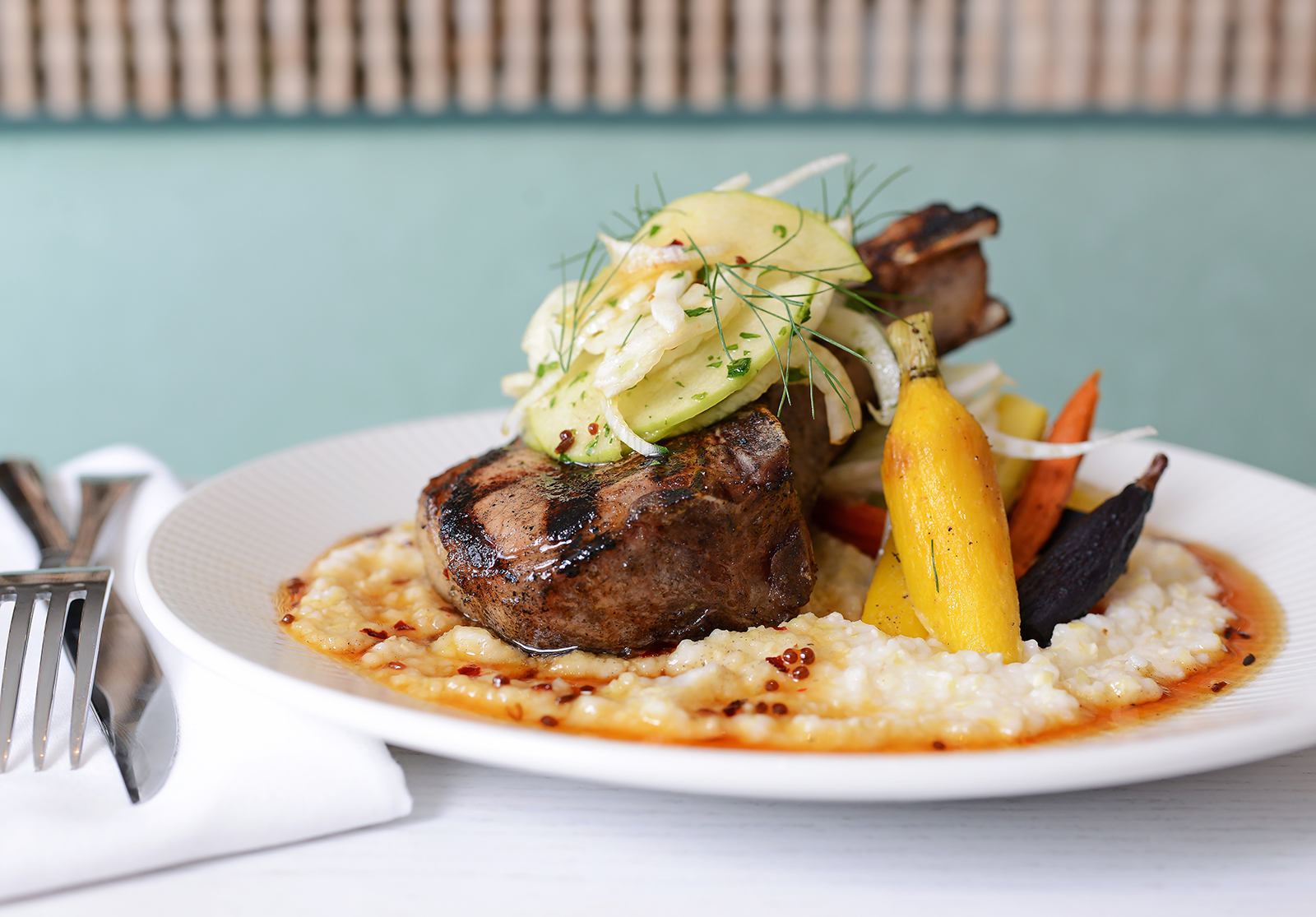
Today, it’s rare to find Autry in one place, as she owns and operates two restaurants: The Regional Kitchen and Public House, with partner Thierry Beaud, in West Palm Beach, and Honeybell in Palm Beach Gardens. And while the restaurants are different in every way, you cannot deny Autry’s expert mix of authentic Mediterranean flair with her Southern roots.
Her cooking classes, offered via Zoom and in person at Kai-Kai Farm in Indiantown, have been a huge success. What is the secret to her success? Well, let’s just say she’s quite good at what she does best. Good food.
Here, Autry shares her passion for food and what we can only imagine is her amazing future as a successful chef in this town.
The Interview
You spend a lot of time in the kitchen. What makes for a positive working environment?
You’re pretty much standing in the same place in the kitchen, running back and forth between refrigerators and fire. However, what really makes for a good working environment is teamwork.
And creating a nurturing, positive work environment—one that is also organized and has a clear line of communication —and keeping it upbeat and pleasant.
So, the kitchens today are not what they used to be in the old days when many of the executive chefs yelled and screamed at their sous chefs?
[laughing] I think there are still some who have that dark side within. However, that aggressive older generation of chefs is unproductive, and it’s not a pleasant working environment.
I mean, who wants to go to work and get yelled at? That’s the last thing I want to do. When you have a calm, pleasant work environment, you also have higher staff retention and maybe lower blood pressure!
What are the key tools every chef should have in their kitchen? And what are your top three?
Obviously, knives. A chef’s knife is very versatile for 80 percent of what you have to do. For instance, knowing when to use a fillet knife to cut something very thinly, like fish, or a serrated-edged knife for cutting bread and tomatoes… It’s just knowing when to use the right tools.
Also, having the right pot wear is very important. Whether it is cast iron or stainless steel. Spoons are also a must in a kitchen. I am quite the spoon collector, just ask my husband! We have two silverware drawers in our kitchen! [laughs] And I think I have boxes of them in the garage, too.
So, my top three are my spoons and a utility knife [somewhere between a chef knife and a paring knife, which is a smaller knife that’s helpful for doing a lot of things]. Then, a wide-shaped peeler, which I use for many things, not just for peeling but also for cutting.
What inspires your culinary creations?
I’ve been fortunate enough to travel a lot in my career, working with some incredible people. So, a lot of my inspiration comes from my training and my travels. As we all get older, we get more nostalgic, so a lot of that inspiration comes from the food that I grew up on.
So, when did you decide to become a chef?
I started entering cooking competitions as a child, so I always cooked. I never thought of it as a career path because my whole family was made up of educators. So they stressed that I had to go to a big college to become a doctor, pharmacist, or lawyer…
During my junior year in high school, I came across Johnson & Wales University, and it just kind of clicked. I knew I loved to cook, and I could do something with this. So, I decided in high school that was the path I wanted to take, and I’ve never done anything else.
What was the first restaurant that you worked for?
In high school, I actually worked for a Lonestar Steakhouse as a hostess because you couldn’t work in the kitchen unless you were eighteen. But on the side, I worked at the local Convention Center as a cook, assisting the Executive Chef, who was actually from Johnson & Wales University.
She really mentored me throughout high school, and then I was accepted to Johnson & Wales in Charleston, South Carolina, where I was employed in several restaurants.
I continued on that path until I came down to Florida for an internship at The Breakers in Palm Beach. I was here in 2001 when 9/11 happened and got laid off from that internship, so I transferred to Johnson & Wales in Miami.
From there, I worked at several restaurants in Fort Lauderdale and Miami to gain experience at different levels and find my niche. During my junior year of college, I began working with Michelle Bernstein.
How was that experience?
I worked with Michelle first in Miami and then in the Riviera Maya area of Mexico, where I lived for four years. All in all, I worked with her for 13 years.
After a huge success with Michelle Bernstein and in other restaurants, what prompted you to open your own restaurant?
As a creative person, I always wanted to find a place where I could do it my way, I guess. I had worked at all these unique places, but I really wanted someplace to call my own.
I met my partner, Thierry, about seven years ago. We worked together on several small projects, which led us to start a business together and open The Regional.
The Regional is a large venue. Were you intimidated by the space?
Because I had a strong background in hotels, I wasn’t intimidated by a large space. The Regional is a very large restaurant, true. We have a large dining space, and because I’ve always loved hosting parties and doing more than just being a restaurant,
I enjoy being a part of this establishment. That’s what drives me as a chef: the fact that I get to create memorable occasions for people who are not just dining out—like baby showers, wedding rehearsal dinners, birthdays, and graduations.
We also do a lot of business events like business financial dinners and conferences, things like that. So, for me, I wanted to create The Regional as a place where people could come and experience it in many different ways.
Had you ever cooked Southern food professionally before you opened The Regional?
No, I was actually French-trained and worked with Mediterranean cuisines. But I saw a void in the Palm Beach area, where no one was doing Southern cuisine at a higher level.
Therefore, I took the approach of opening a restaurant that reflected my travel experiences and my background in food.
The Regional is very successful, so what prompted you to get involved with Honeybell?
It’s always nice to be excited about something else, too. I’ve always aspired to have something else going on than just one place. The opportunity with Honeybell presented itself, and I was really excited because we live in Palm Beach Gardens.
Even though it is another restaurant in the area, it is not The Regional. There’s still a little bit of a common thread between them because there’s me, and I don’t know how not to be me. I think it’s important to be yourself, to be authentic.
I learned that from my grandfather. Honeybell is different. The restaurant serves breakfast, lunch, and dinner. It’s inside a resort, so it facilitates the resort, but it serves our community. It’s a family-friendly type of place.
Tell me about your team.
My team is amazing. This is not a business that you can do alone, you know. So, most of my team has been with me for a decade, and I don’t know what I would do without them.
As an executive chef, one of the things you learn is how to delegate and trust your team to execute your vision and carry out your work. So, it’s good to know that you can lean on them when you need them, like when you take a day off!
Tell me about your experience on “Top Chef.”
It was a terrifying experience, but it also did a lot for my career. After that show, I got to cook with Martha Stewart, which was on my bucket list! The exposure to “Top Chef” also allowed me to gain visibility, not only nationally but also within my community.
What is your favorite dish to prepare?
Wow! This is a very difficult question. At The Regional, I would say our Tomato Pie is a favorite of mine. I do like getting my hands in it; it’s a very labor-intensive dish, even though its presentation wouldn’t suggest it. It’s a small pie, but there’s a lot of work that goes into it.
And what’s your least favorite dish to prepare?
[laughing] Oh, boy... Salmon. I can’t stand cooking salmon because you sell so much of it! [laughing] I’d be happy if I lived my whole life and never saw salmon again. And then, once a year, I’ll crave salmon, and I ask myself, “What’s wrong with you?” It’s very delicious on both our menus, by the way!
Why is it so important for chefs to work with regional suppliers?
I think, in general, the whole farm-to-table movement has become somewhat clichéd. And I’m very sensitive about it because, as I said, I grew up on a farm. So, for me, it’s always been very natural to buy what’s close to you.
In the end, you support your community and what is native to your area. I’m a true believer that if you really give back to the community that you are in, it’s going to come back to you. As chefs, we want the general public to support us.
As small businesses, it’s important that we take the same approach to what we buy. In addition, it’s important that we support other families and people in our community to succeed.
“I’m a true believer that if you really give back to the community that you are in, it’s going to come back to you.”—Chef Lindsay Autry
Now I know that you are well connected to the Palm Beach Food & Wine Festival [your husband, David Sabin, organizes it], so tell me about your experience at last year’s festival?
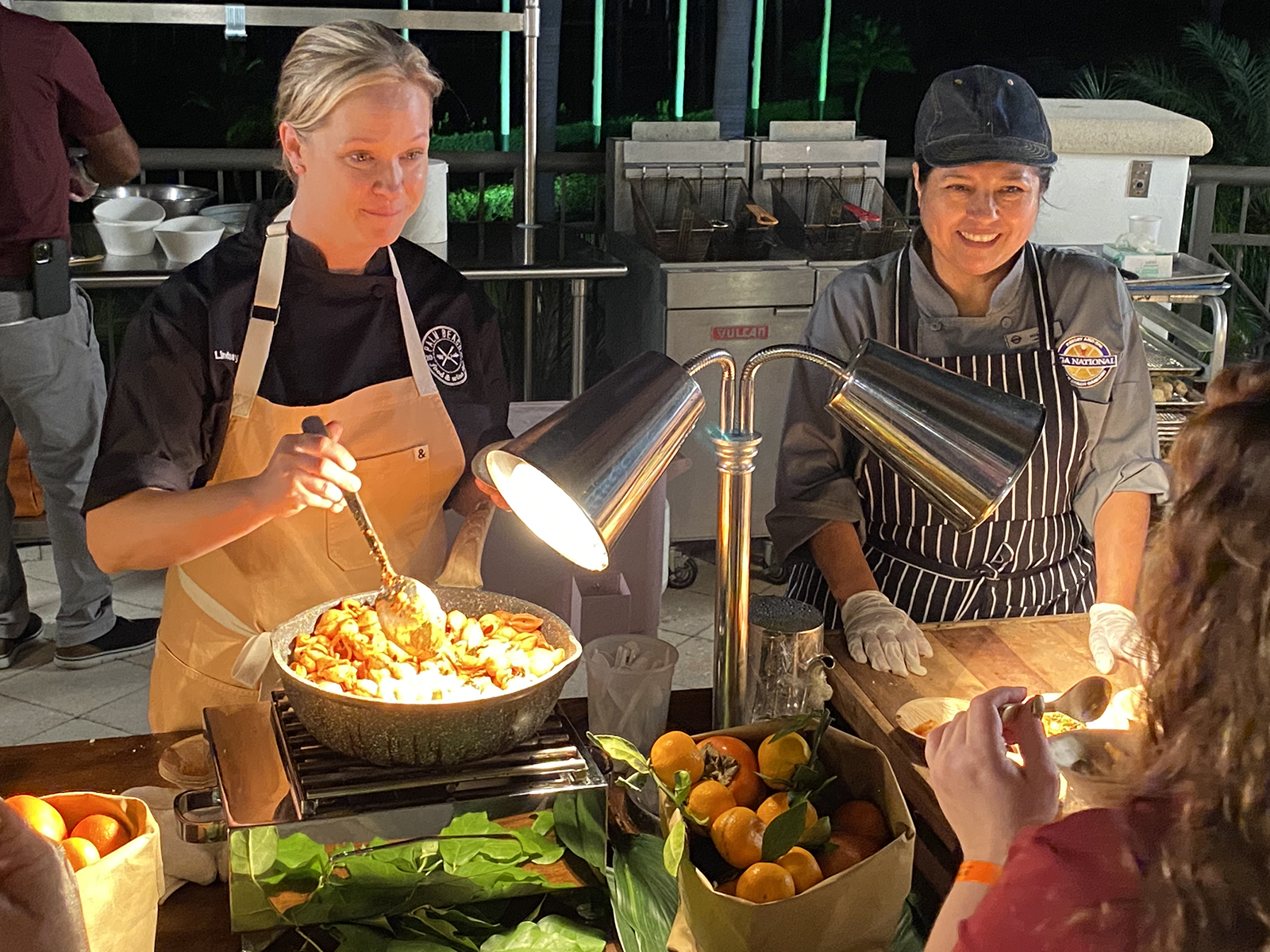
After the pandemic, it was a pleasure to be back and have all the chefs who participated in it cooking together again. It was one of the first food events to return, and it definitely felt good to see so many people excited about the festival and all the events we host. And for me, it was really great because Regional hadn’t been open for 17 months.
The first thing I did was the festival before we opened our doors. Some of the chefs hadn’t been together for two years because of COVID. The festival really did bring back that passion and joy to be able to do that again.
Why do you think food festivals are so popular with people and foodies in particular?
Everybody has to eat, and everybody likes to eat. I think in general, food, especially in the last ten years, has become more pop culture. If you look at social media, it is everywhere!
Obviously, I am a chef, so I follow a lot of food accounts. But even in general, from television to podcasts, everything culturally, and in our social media age, is based on food. For me, it’s a great pleasure because it is what I do.
But I do think that food events drive a lot of people because they are genuinely excited about food. We have a lot of different green markets and stores that we didn’t have 20 years ago! They bring you closer to the actual growers and artisans.
In general, people are more interested in food, and it’s great for us in the business because we get to diversify a little bit and not be stuck in a kitchen cooking. We get to get out in front of people and get to interact with them more.
Kitchens around the globe are typically male-dominated. What challenges do women face, and what changes are needed to shift the balance in the kitchen?
This question is always a hard one for me because people ask me how I feel as a female chef. For me, I am just a chef. Yes, it is male-dominated. Yes, it has always been that way.
I do see a lot more women in kitchens now. Even on my own, I have way more women in my kitchen in the last five years than I ever did before.
And even though I worked for a female chef for most of my culinary career, most of the time it was Michelle and me, the only female chefs in the kitchen. There are several reasons for it. It is a very demanding job, both physically and time-wise.
And it’s always seemed strange to me because women have always been expected to be the cooks at home, but not to be professional cooks. Which is an oxymoron.
But I think as women, we bring a variety of things to the table. Women, by nature, tend to be more nurturing. So, where we cook comes from a different place.
I don’t think it makes it any better, just different. It actually makes for a good environment when you have more of a mix —just like culturally, with people from various backgrounds and diverse mindsets.
It’s always seemed strange to me because women have always been expected to be the cooks at home, but not professionally. Which is an oxymoron.
If you were to choose a dish to describe your personality, what would it be? Explain.
Oh, man! I have this fish dish I have made for several years called Cobia. It’s on the menu at The Regional. It’s hand-rolled gnocchi with country ham, oyster mushrooms, pea greens, ricotta dumplings, smoked ham hock broth, and crème Fraiche.
I guess that embodies me a little bit because it definitely has a bit of a ‘cheffy’ professional touch, but the flavors and the inspiration behind it are very nostalgic and, for lack of a better word, a little trashy—like pasta and ham! [laughs] All delicious stuff!
The fish is wild cod and seared with herbs. The intent of the dish is to simply enjoy something tasty and satisfying. And I feel that’s how I try to approach all of my food.
There’s a lot of nostalgia and craving in what I am creating, but I tend to lend that professional touch. For normal people [non-chefs], I think there’s nothing more disappointing than going out to a restaurant, ordering and paying for something, only to realize you could have done it better yourself.
Share a cooking tip or technique you use when sourcing ingredients, cooking, and prepping in your kitchen that people can apply in their home kitchens.
One thing I like to do whenever I teach cooking classes is show how to grate a tomato using a box grater. This is actually a Spanish technique where you cut a tomato horizontally in half.
And then, using a cheese grater, you can create fresh tomato pulp. Unfortunately, we tend to buy tomatoes at the grocery store because they look beautiful, but then we come to find that they are very mealy or watery and unappealing. That happens a lot with tomatoes at the grocery store.
There’s nothing worse than buying ingredients that you’re disappointed in, so if you take these tomatoes and you grate them, you can make this fresh tomato pulp that you can either add olive oil to and make a unique vinaigrette that you can dress a salad with, or cook it and make fresh tomato sauce. Simply delicious!
Meet the Chef
Name: Lindsay Autry
Nickname: Chef – my parents call me “Chef”
Where you live: Palm Beach Gardens, Florida
Family: Husband, David Sabin, and two-year-old son, Jack.
Restaurant(s) affiliation and location: Chef/Owner of The Regional, West Palm Beach; Honeybell, PGA National Resort
Hometown: Fayetteville, North Carolina
Years as a chef: 18 years
Awards: James Beard Foundation Award recipient.
Dishes you’re re-known for: Fried chicken and a dish that’s called Tomato Pie. Also known for working with a lot of seafood, especially Florida seafood, which has always been one of my focuses in many of my menus. But I’m also known for Southern and Mediterranean cuisine.
Social channels: @Lindsay_Autry (Instagram)