
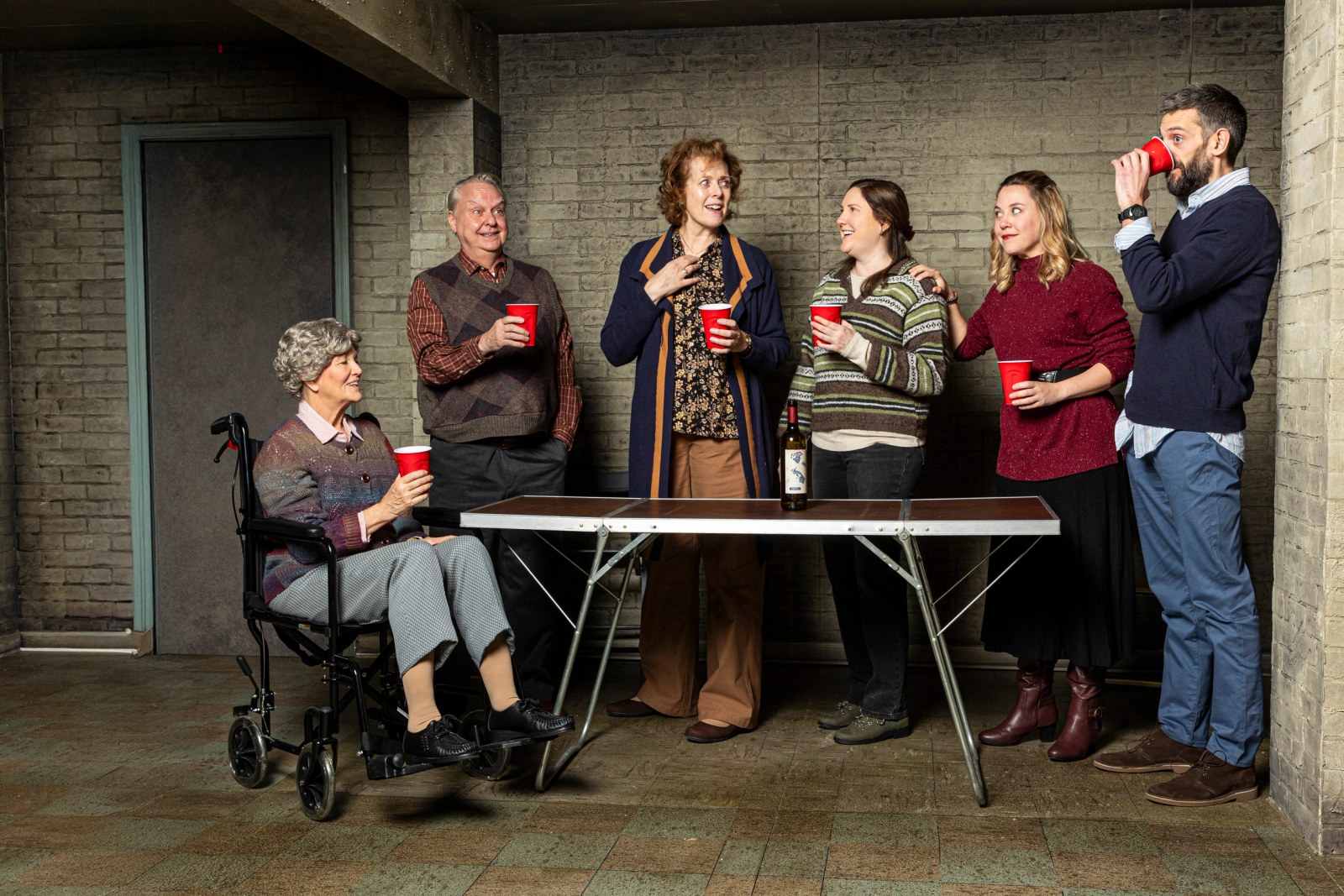
The Humans is a play that leaves you thinking like most plays produced at Palm Beach Dramaworks do. The production features a fantastic set crafted by a stellar crew.
If the monsters out there read about what happens at a human family holiday celebration, perhaps they too would be afraid of the dark—those unknown spaces, places, and things that go bump in the night. Such is the theme of American playwright Stephen Karam’s play, The Humans.
The play opened on Broadway in 2016 after an off-Broadway run in 2015. Winner of the 2016 Tony Award for Best Play, Karam was also a finalist for the 2016 Pulitzer Prize for Drama. He wrote Sons of the Prophet and Speech & Debate and teaches playwriting at The New School in New York.
Now playing at Palm Beach Dramaworks, The Humans is a comedy-drama directed by J. Barry Lewis. He has taken a journey of creativity at PBD, and this play marks his 50th directorial debut at this theatre. The play includes clashes between generations, the unknown world of Alzheimer’s disease, infidelity, and poverty, and explores tensions between social classes. It tells the story of the Blake Family, a dysfunctional family [is there any other kind?] that gets together for Thanksgiving one cold fall in New York.
Karam opens the first act with most of the Blake Family arriving at Brigid Blake’s (Casey Sacco) run-down, two-story apartment in New York’s Chinatown. If anyone has experienced a much-dreaded visit from a parent at their first apartment, they might be sympathetic to Brigid’s dilemma. Her place is in one of the most unfavorable places with pests, faulty electricity, and high rent—the quintessential scene that sets the tone for the rest of the play.
The first act opens when Brigid, a musician, and her boyfriend, Richard Saad (Daniel Kublick) welcome her parents, Eric and Deirdre Blake—played by Andy Prosky and Anne-Marie Cusson—her sister, Aimee (Lindsey Corey), a lawyer who lives in Philadelphia, and her grandmother “Momo” (Laurie Tanner), Eric’s mother, who suffers from Alzheimer to their apartment.
Eric, an Irish-American filled with ideals but lacking moral values, adopts an attitude toward Andy as he questions the younger man about his finances and career choices—a land mine Andy does best to sidestep, to no avail. As a 38-year-old, Andy explains, he is living “like this”—almost in poverty—as he waits for a hefty inheritance when he turns 40—an answer Eric dislikes.
In this play, nothing really gets resolved other than secrets are revealed, prayers are recited at the Thanksgiving dinner table, and the meal is eaten—a typical Thanksgiving dinner for many people in America. But, underneath it all lies the family tension, which drives the narrative drama. And it feels intimately familiar to us.
My favorite part in the play is when Eric reveals his infidelity, and Deirdree, an obsessed Weight Watchers member, copes with this news by eating everything at the dinner table, including dessert. Clearly, we see that his affair, which led to his job loss (a consequence of having sexual relations with another teacher at his school), is actually not news to her. Still, she feels exposed and vulnerable as she watches her daughter’s reaction.
Adding another layer to the family conflict is Aimee’s breakup with her boyfriend, which is causing her physical and emotional pain. The parents are upset that their daughters have left home and have abandoned their Christian religion. This, too, adds to the play’s overall theme: the human condition—fear, abandonment, pain, illness, betrayal, loss of mental ability, and financial instability.
The Blake Family drama is displayed simultaneously—one character interrupting another and speaking over each other in the hope that their voices would be heard and their human need to be appeased. The nature of the discussions is believable, thoughtful, funny, and sad, so close to our own. Karam’s compassion displayed for a family member dealing with an incurable disease such as Alzheimer’s is something some of us can relate to. The mental disconnection and a few moments of lucidness break your heart.
After watching this play, I imagine that if the monsters out there told scary stories to their kids, The Humans would be a tale on top of their list. Karam’s play presses on this point by presenting many opportunities to exhibit his connection to human nature and the everyday challenges we experience.
The Humans is a play that leaves you thinking like most plays produced at Palm Beach Dramaworks do. The production features a fantastic set crafted by a stellar crew. But as you walk out of the theater, you are keenly aware that Karam’s intimate and increasingly oppressive drama is a marvel, not just because of the fine writing and acting by the PBD cast, most especially Prosky and Cusson’s brilliant performance, but of the overall human reality, where the bubble of happiness is repeatedly burst onstage. Still, the hope of a brand new day is waiting out there.
To learn more about The Humans, check out Palm Beach Dramaworks’ website at www.palmbeachdramaworks.org. The Humans is playing through March 2, 2025.