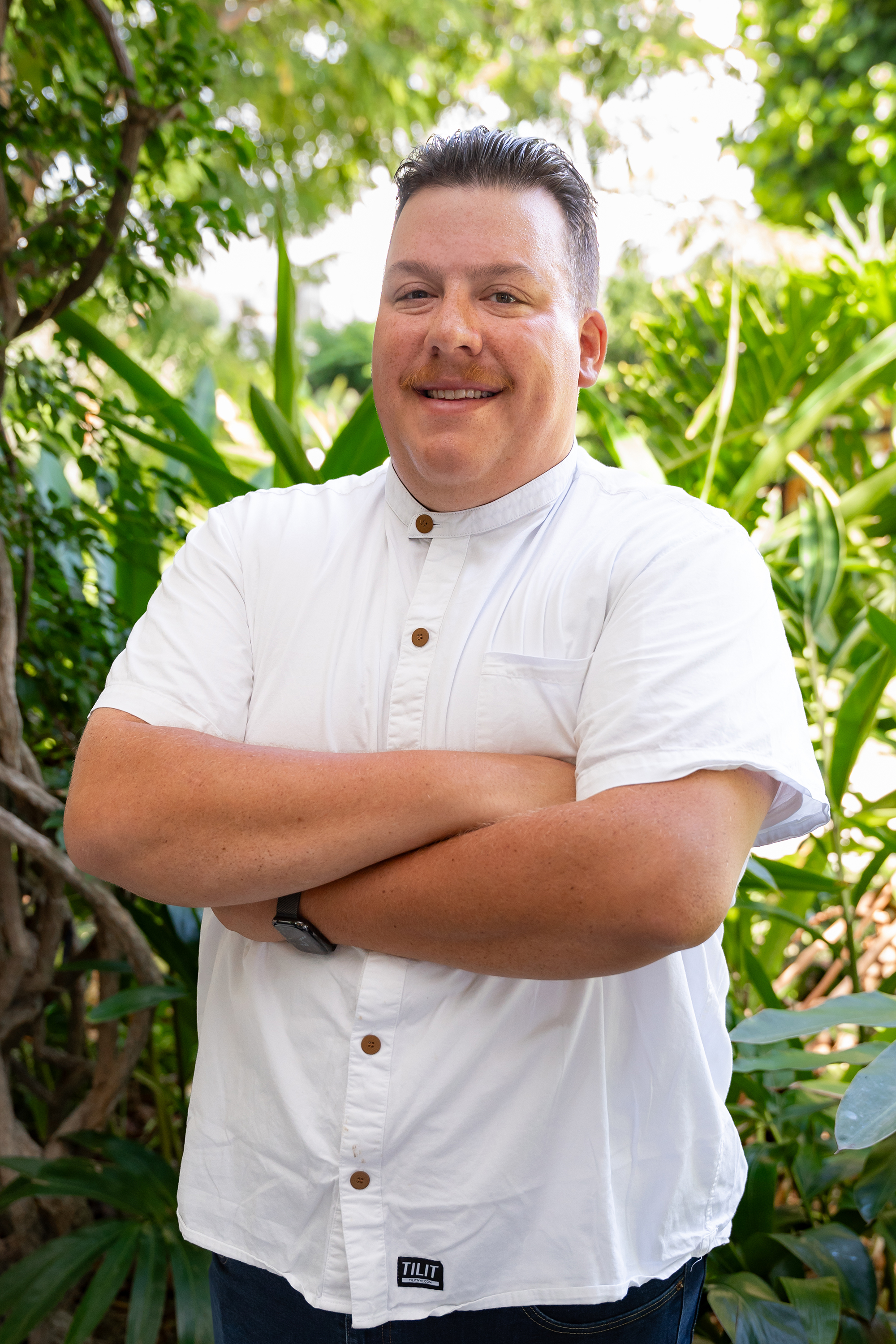
“I've always really liked cooking. It's something that I've always been naturally good at. I’ve worked in kitchens since high school. I've never had a job outside a kitchen. This is probably the closest that's out of the kitchen for me right now,” says Field of Greens’ Director of Culinary Operations, Chef Thomas Op’t Holt. “FOG has been a nice experience, though. It's a lot different than what I'm used to, but it's really good.”
FOG is good, he repeats, but he still feels a physical restlessness. What culinary experts would call “ghost muscle” memory, which reminds a chef he's traded the heat of a single hot line for the chronic, invisible weight of consistency across multiple kitchens. The chef’s coat no longer smells like charred shallots, fryer oil, and sweat. It smells like fresh laundry, steering-wheel leather, and espresso.
In this exclusive interview, Chef Thomas, who’s led notable kitchens including 50 Ocean and Deep Blu Seafood Grille, and trained at the Culinary Institute of America, walks us through his career and his time in Chicago working for Chef Mychael Bonner under the Chicago-based restaurant group Lettuce Entertain You, which managed 36 Maggiano's Little Italy locations nationwide. And with Chef Lindsay Autry’s Honeybell Restaurant in Palm Beach Gardens, where he learned a great deal in the kitchen from this top chef, who helped him pen his own mantra, “Never make the same mistake twice.”
The Interview
Maritza Cosano: Chef Thomas, you’ve worked with some top chefs in your career. Who has influenced you the most?
Thomas Optholt: Lindsay Autry. She is so incredible. When I went to work at Honeybell in PGA National, I hadn't worked with a chef like that in a long time. Not since I was in Chicago. So, it was really refreshing to work with her.
MC: And what was it that you found so refreshing?
TO: She’s cool. We would go outside, rip a cigarette, and just talk about the day. But she nerds out on food. She knows food, the scene, the industry. She’s got that Top Chef clout, too. I remember one night I fell asleep on the couch at home, and my wife had put on “Top Chef,” the season Lindsay was on…
MC: Bravo TV’s ninth season of “Top Chef”.
TO: Right…and I heard her voice, and I immediately woke up. She’s remarkable. What she and her husband, David, do with the Wine Spectator Palm Beach Food & Wine Festival is so impressive. But she's the driving force. Her organization, diligence, and attention to detail are amazing.
MC: I’ve read that female chefs are better in that department. Is that correct?
TO: I think so. My old chef, Mychael Bonner, who played a major role in the early days and national growth of Maggiano's Little Italy, always said that he loved working with women chefs because they had such attention to detail. And it's funny, I grew up with a single mother, and she always brought me around my aunts. I'm a Leo, 6'2", and I'm a boisterous type of guy. Still, I have no problem working with women in this industry. They have a more mindful approach. And that’s what I took from her (Chef Autry), and that's what's really great about Field of Greens.
MC: What brought you to Field of Greens?
TO: Daniel Morris, who is the president and vice President overseeing strategic growth and operations for Field of Greens, called me one day. He told me that they were growing fast, so they needed a director of culinary operations.
MC: Field of Greens is a different kitchen than, let’s say, Honeybell. So, how do you manage this type of operation?
TO: Well, it's not like apples and oranges. It's like Fujis and Honeycrisps, you know? You still want to procure the best product, right? Like, you still have to be mindful of that. The difference is, in a 3-star Michelin restaurant, you're going to be bringing in, like, crazy expensive stuff from all over the world. One of the first things I did at FOG was change how we sourced our chicken. Before I started, they were buying chicken breasts from various places, so prices were fluctuating like crazy. Between $2.90 a pound and $5 a pound. So finding the right source was a game changer.
MC: How was it to change your chef’s hat to a manager’s hat? Moving from doing hands-on cooking tasks to supporting and guiding a team?
TO: (He smiles knowingly) I think the one thing that's been tough for me is when you're in the kitchen, you have, like, your lists, right? And you walk into the kitchen, you say, I have to break down fish, I have to break down meat, I have to get a special soup going, and then I have to do service for 100 people. And you have that, like, instant dopamine hit—a full dining room of happy people. And you go through the day like this. Maybe you were a man short, and you still did it, getting that instant gratification of just, like, getting it done. It's like a shot in the arm, you know what I mean? Being in the kitchen is really fun, and that's what I kind of miss.
MC: You miss the action.
TO: Yes. I’m doing a lot of things now, with a longer process. But I do miss the action. I miss the show. Funny thing, my arm hair is growing back now for the first time in 22 years of getting it singed off over the burner. I'm at a point now where I've been cooking for over half my life. I'm gonna be 40 in two weeks, and I've been cooking for 22 years.
MC: And what has been the highlight of that 22-year career? What has been dearest to your heart?
TO: Dearest to my heart was Brick and Barrel in Jupiter. We took over a small spot in Abacoa, formerly called Aaron's Table. I felt my most creative there, doing special dinners. I remember my aunt always made beef stroganoff for my uncle's birthday, so I put it on the menu, and it was a hit.
When people hear that I worked for Let Us Entertain You and PGA National, they say, " Oh, that’s nice.” And it definitely was. But that was more on the management side. I liked Brick because I was still sourcing ingredients, I didn't answer to anybody, and I got to cook.
MC: And which one was your most challenging?
TO: PGA National was the most challenging. I walked in there like I thought I was hot shit, and I got humbled real quick. My first Thanksgiving, I'll never forget. Lindsay has a sous chef named Leo, who worked with her for like forever. We were doing 500 people for this Sunday brunch. , The hotel was full, and the pool bar also came out of that kitchen. So we're cooking for 500 on a buffet. So when you have a 500 buffet, like, you have to cook for like 600, 700. And I just kept taking projects on myself, kept doing it myself, kept doing it myself.
It was like an hour before the brunch. And Lindsay's the type of person who, if the buffet start time says 11 am, you fucking better be ready at like, like 9:45. She doesn't play. And it was like 30 minutes before guests were to arrive, and there was still no food on the buffet. And she pulled me aside and was basically like, “Pull your head out of your ass. You need to figure this shit out quick.” I pulled dishwashers; I had spa techs helping us with stuff. I just kept pulling people in. It was a fucking nightmare.
MC: But how was the execution in the end?
TO: Well, I'll tell you what happened. A Bat-Signal went off at 11 minutes to midnight, and Leo walked in and absolutely saved my ass. A couple of days later, Lindsay and I sat down. She's like, “You know, if Leo didn't walk in, you were screwed, right?” And I was like, “Yeah.”
From the guest perspective, they sat down at 11, and the buffet was ready at 11. But what happened that day was a tough lesson for me, though. It was humbling. Lindsay has a way of, like, humbling you but also being like, learn from this, grow from this. I have a saying for myself: Never make the same mistake twice. That day really pushed me. And from that point on, I worked very hard for the time that I was there.
MC: But you were no stranger to hard work…
TO: True, but you see, Honeybell was the hotel's main à la carte kitchen. So we opened at 6 am for in-room dining, then started breakfast at 7 am, and the pool bar opened at 10 am. Then, the spa opened for food at 11. Honeybell opened for lunch at 11 and closed at 11 pm. So we were open from 6 am to 11 pm. There were many days that I was there from 5 am to 12 midnight or later. So, yeah, I had to put in the time, and I'm no stranger to that.
But I can procrastinate because I really do thrive under pressure. Sometimes I put something off so I have to do it quickly; you know what I mean?
MC: You’re still searching for…
TO: That dopamine fix.
MC: So what is your cuisine philosophy?
TO: Being mindful of the guests, what they want, what's selling, what's not. And then for FOG, it's just being mindful, somewhat creative but approachable, and just making sure that we understand what our guests want.
MC: In your free time, if you could do anything, what would it be?
TO: I'd love to fancy myself a food critic.
Now, I didn't see that coming.